Database
Turso cloud SQLite, schema, categories, edge types, and the relational model.
Schema
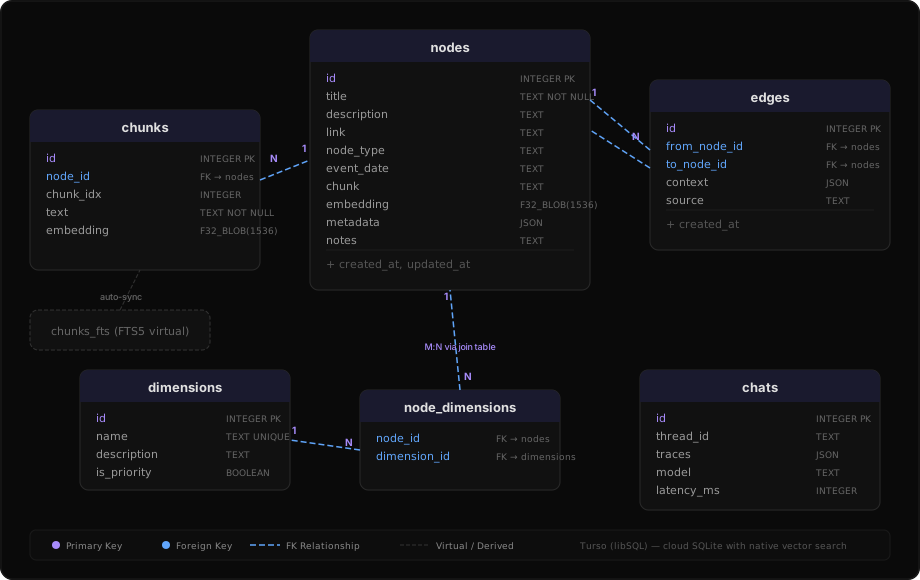
SQLite and the Relational Model
The wiki-base is a relational database. That means everything is stored in tables with rows and columns, and tables are connected to each other through foreign keys. If you know spreadsheets, think of each table as a sheet, but sheets can reference rows in other sheets.
We use SQLite, the most widely deployed database in the world. It's a single-file database engine, no separate server process. Turso hosts it in the cloud so the web app, bot, and MCP server all share one instance.
| Detail | Value |
|---|---|
| Provider | Turso (cloud-hosted libSQL, a SQLite fork) |
| Client | @libsql/client |
| Vector | Native F32_BLOB columns + vector_top_k() |
| Full-text | FTS5 virtual tables with auto-sync triggers |
Tables
nodes
The central table. Every piece of content, person, organization, and topic is a node.
| Column | Type | Description |
|---|---|---|
id | INTEGER PK | Auto-incrementing |
title | TEXT NOT NULL | Node title |
description | TEXT | One-sentence summary |
link | TEXT | Source URL |
node_type | TEXT | Category (see below) |
event_date | TEXT | ISO 8601 date |
chunk | TEXT | Raw source text |
embedding | F32_BLOB(1536) | Node-level vector |
metadata | JSON | Type-specific metadata |
notes | TEXT | User notes / analysis |
chunks
Source text split into smaller pieces for search. See Indexing & Search for how chunking works.
| Column | Type | Description |
|---|---|---|
node_id | INTEGER FK | Parent node |
chunk_idx | INTEGER | Position in sequence |
text | TEXT NOT NULL | ~2000 chars |
embedding | F32_BLOB(1536) | Vector embedding |
edges
Directed relationships between nodes.
| Column | Type | Description |
|---|---|---|
from_node_id | INTEGER FK | Source node |
to_node_id | INTEGER FK | Target node |
context | JSON | Type, confidence, explanation |
source | TEXT | How edge was created |
dimensions
Tags/categories. Many-to-many with nodes via node_dimensions join table.
chats
Discord bot interaction traces. Full MCP tool call logs, timing, Discord context.
Categories
11 node types stored as node_type on the nodes table.
| Category | node_type | Description | Sort |
|---|---|---|---|
| Podcast | podcast | Latent Space episodes with full transcripts | Recent |
| Article | article | latent.space Substack posts | Recent |
| AI News | ainews | Daily AINews digests from smol.ai | Recent |
| Builders Club | builders-club | Community meetup recordings | Recent |
| Paper Club | paper-club | Deep-dive paper discussions | Recent |
| Workshop | workshop | Conference talks, tutorials | Recent |
| Event | event | Scheduled community events (paper club, builders club sessions) | Recent |
| Guest | guest | People, guests, speakers, authors | Most connected |
| Entity | entity | Organizations and technical topics | Most connected |
| Hub | hub | Internal structural anchors (hidden) | - |
| Member | member | Discord community member profiles | - |
Edge Context Model
edges.context stores JSON with relationship semantics:
interface EdgeContext {
  type: EdgeContextType;       // Relationship type (see table below)
  confidence: number;          // 0–1
  explanation: string;         // Human-readable description
  created_via: string;         // 'ui' | 'agent' | 'mcp' | 'workflow'
  role?: string;               // e.g. host/guest for appeared_on
  depth?: string;              // mention / discussion / deep-dive
  valid_from?: string;         // Temporal bounds
  valid_until?: string;
}
Edge Types
14 relationship types stored in edges.context:
| Type | Direction | Example |
|---|---|---|
created_by | Content → Creator | Article → Author |
features | Whole → Part | Episode → Guest |
appeared_on | Person → Content | Guest → Episode |
covers_topic | Content → Topic | Episode → "RAG" |
affiliated_with | Person → Org | Researcher → OpenAI |
expert_in | Person → Topic | Engineer → "agents" |
part_of | Part → Whole | Talk → Conference |
cites | Content → Source | Article → Paper |
related_to | Any ↔ Any | General connection |
interested_in | Member → Topic | User → "agents" |
extends | Work → Prior | Paper → Earlier paper |
supports | Evidence → Claim | Study → Hypothesis |
contradicts | Counter → Claim | Finding → Earlier claim |
source_of | Derivative → Source | Summary → Original |
Metadata by Category
Stored in nodes.metadata as JSON. Each category has its own shape.
Podcast / Builders Club / Paper Club / Workshop:
{ "publish_date": "2025-01-15", "series": "latent-space-podcast", "duration": "1:23:45", "video_url": "https://..." }
Guest:
{ "role": "ML Engineer", "affiliations": ["OpenAI"], "expertise": ["agents", "RAG"], "twitter": "@handle" }
Entity:
{ "org_type": "startup", "website": "https://...", "founded": "2023", "hq": "San Francisco" }
Article:
{ "source_type": "blog", "authors": ["swyx"], "publish_date": "2025-02-01" }
AINews:
{ "source_type": "newsletter", "publish_date": "2025-02-01" }
Member:
{ "discord_id": "123456", "discord_handle": "user", "avatar_url": "...", "joined_at": "2025-01-01T00:00:00Z", "last_active": "...", "interaction_count": 5, "interests": ["agents", "RAG"] }
Example Queries
-- Count nodes by category
SELECT node_type, COUNT(*) as count
FROM nodes WHERE node_type IS NOT NULL
GROUP BY node_type ORDER BY count DESC;

-- Most connected guests
SELECT n.id, n.title, COUNT(e.id) as edge_count
FROM nodes n
JOIN edges e ON e.from_node_id = n.id OR e.to_node_id = n.id
WHERE n.node_type = 'guest'
GROUP BY n.id ORDER BY edge_count DESC LIMIT 20;

-- Recent podcast episodes
SELECT id, title, event_date, description
FROM nodes WHERE node_type = 'podcast'
ORDER BY event_date DESC LIMIT 10;

-- Edges for a specific node
SELECT e.id, e.context, src.title as from_title, tgt.title as to_title
FROM edges e
JOIN nodes src ON src.id = e.from_node_id
JOIN nodes tgt ON tgt.id = e.to_node_id
WHERE e.from_node_id = 42 OR e.to_node_id = 42;